ITC Prep · Online preparation

ITC Prep: your online preparation for the ITC

This page is for everyone preparing online for the Instructor Training Course – whether you then take the ITC with us on La Palma or at another center.

Your SSI ITC Manual is the basis. Every module refers to it: you see which lessons you work through in the manual and what we add with webinars, tools and quizzes. The manual explains how SSI does it – here you practise applying it.

Before the ITC starts, you work through the digital learning and take the pre-assessment exam. 

  • Chapters 1–6 · Assistant Instructor
  • Chapters 7–10 · Instructor
  • IE outlook
1 Start: where do you stand? 2 tasks

Before you dive into the manual: an honest look at where you are. The quiz shows where you are already confident, the checklist what SSI requires as a minimum.

Quiz: Ready for the ITC?Find out where you stand right now. Take it again at the end of your preparation.
Open quiz
Sign in to save notes here
Success

0 of 8 completed

Show Punkfish ITC preparation calendar

How to work with ITC Prep

Work module by module: first the lessons in the ITC Manual, then what we add, then the self-check. Where there is a note, write to us – your Instructor Trainer reads along and answers here.

The order follows the manual. You can refresh your dive theory (module 2) alongside – it is a prerequisite: in the ITC itself you no longer learn theory, you learn how to teach it.
Your diving experience

In the ITC you teach skills and give presentations – you bring diving experience in different conditions with you. Enter what you have done so far: it helps us support you where you need it.

Sign in to save notes here

Where are your strengths, where are your gaps? What would you like to practise before the ITC?

Sign in to save notes here
2 Fit in dive theory (pre-assessment) 7 tasks

Before the academic sessions start, you take the SSI pre-assessment exam in your digital learning.  That is the part that counts.

Here a short check per topic helps you find your gaps. Everything under “optional” is just for refreshing – only take what you need for your gaps. Tick a topic off when you can explain it without looking things up.

Strong in Diving Theory

In the ITC you won’t learn new theory – it’s all about how to teach it. So make sure you’re already solid beforehand.

In your SSI ITC Kit you’ll find a pre-test right at the beginning. It can help you assess your current knowledge.

Here are a few useful links that can support you alongside the materials from your previous courses.

Quiz: Dive Theory – Pro CheckTest your dive theory at professional level. Your result appears here.
Open quiz

Dive physiology

Breathing, circulation, equalising, barotrauma, nitrogen, oxygen.

What matters

Quiz: Dive knowledge – pro checkDive theory at professional level. Your result appears here.
Open quiz
optionalMore to refresh (4)

Decompression theory

Tissues, saturation, no-deco limits, ascent, safety stop.

What matters

Quiz: Profiles and tissuesMatch dive descriptions to the right profile and heat map.
Open quiz
optionalMore to refresh (4)

General training standards

You do not need to know the standards by heart – but you need to find things quickly.

optionalMore to refresh (1)

Which part of the pre-assessment was hard? What would you like explained again?

Sign in to save notes here
3 Chapters 1–3: SSI, your role, administration 5 tasks

The first three chapters explain the system you will work in: how SSI is structured, what is expected of you as a professional and how the administration works. Sounds dry – but in everyday work it decides whether your courses run smoothly.

Chapter 1: Overview of SSI

Chapters 1–6 · Assistant Instructor

How SSI thinks and why: the training center at the core, how adults learn, the Total Teaching System and who does what in the training team.

ITC Manual · Lesson 1.1–1.5

What you work through in the ITC Manual

History and philosophy of SSI, the fundamentals of learning, the SSI Total Teaching System with standards, training records and the flexibility rule, the education system and the roles in the training team.

What we add

Our page on the SSI education system with practical notes, the matching quiz and OWD Logic: there you see in real course sequences what the flexibility rule allows – and what it does not.

Quiz: The SSI education systemHow well do you know the system already? Your result appears here.
Open quiz

Self-check: can you explain this in your own words?

  • Why is the training center at the core of SSI – and what does that mean for you as an instructor?

    ITC Manual, lesson 1.1

  • How do adults want to learn, and what follows for your teaching?

    ITC Manual, lesson 1.2

  • What does the flexibility rule allow – and where does it end?

    ITC Manual, lesson 1.3 and the training standards; try it out in OWD Logic

No model answers on purpose: if an answer does not come easily, read the lesson again – or write your question in a note.

Chapter 2: Duties of an SSI professional

Chapters 1–6 · Assistant Instructor

From certified assistant to specialty instructor: what you may do, what you must do and how you behave as a professional – towards the environment too.

ITC Manual · Lesson 2.1–2.4

What you work through in the ITC Manual

The role of the certified assistant with direct and indirect supervision, the path to specialty instructor, responsibilities and ethics as a professional, the professionalism self-assessment and environmental responsibility.

What we add

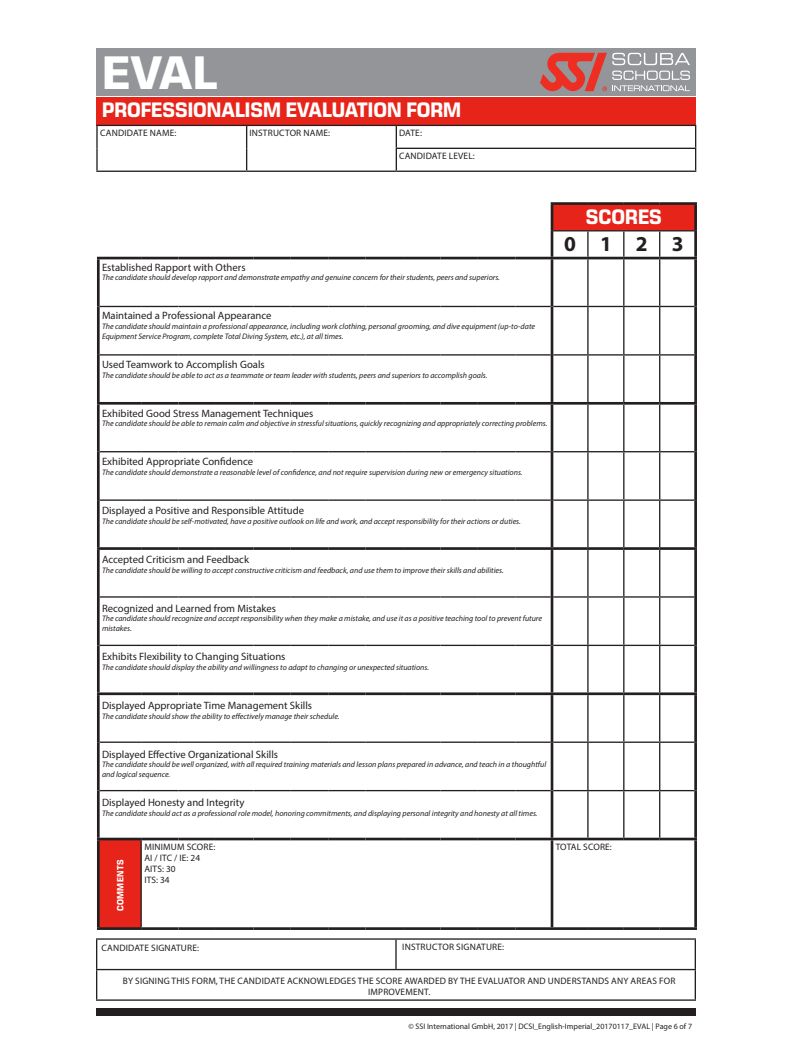
The professionalism evaluation form as we use it in the ITC, and exercises from divemaster training: splitting groups sensibly and making decisions while guiding – exactly what you watch for as an Assistant Instructor when you work with an assistant.

Evaluation: professionalism

These criteria apply to your professional behaviour in the ITC. Have a look now.

Sign in to view
Quiz: Building dive groupsSplit divers sensibly between two guides in everyday situations.
Open quiz

Self-check: can you explain this in your own words?

  • What is the difference between direct and indirect supervision? Give one OWD example of each.

    ITC Manual, lesson 2.1

  • How do you become a specialty instructor, and what does equipment have to do with continuing education?

    ITC Manual, lesson 2.2

  • What do you need to do to stay active as an SSI professional?

    ITC Manual, lesson 2.3 and the dive professional standards

No model answers on purpose: if an answer does not come easily, read the lesson again – or write your question in a note.

What does professionalism mean to you? Where are you already strong according to the evaluation form, and what do you want to work on?

Sign in to save notes here

Being a Dive Professional

Independent of the SSI system – what does it actually take to be a dive professional? What do jobs in the dive industry look like? What do you want to do with your new qualification?

We’ve compiled a set of resources you can check out in advance.

Chapter 3: Program administration

Chapters 1–6 · Assistant Instructor

MySSI, training records, scheduling and quality management: the part students never see, but which carries every course.

ITC Manual · Lesson 3.1–3.4

What you work through in the ITC Manual

The MySSI system with app, user and professional account, the record-keeping system with the different training records, scheduling and organising a course, and quality management (QMS).

What we add

The MySSI Checklist takes you step by step through the most important functions in the app and on desktop. With the OWD course planner you plan a complete course – that makes scheduling concrete.

Self-check: can you explain this in your own words?

  • Which account types does MySSI have, and what can only the professional account do?

    ITC Manual, lesson 3.1; try it with the MySSI Checklist

  • Which training records are there, and what goes into an OWD record?

    ITC Manual, lesson 3.2

  • What belongs in a student orientation session?

    ITC Manual, lesson 3.3

  • What do you use the QMS for – and why is it useful for you as an instructor too?

    ITC Manual, lesson 3.4

No model answers on purpose: if an answer does not come easily, read the lesson again – or write your question in a note.

Standards

Chapters 1–6 · Assistant Instructor

The SSI Training Standards are the rulebook you must follow as an SSI Pro. You don’t have to memorize them, but you must work with them very well and find quick answers to any questions.

Standards matter in every workshop and every practical application; they are the rules you must always observe.

4 Chapter 4: Teaching academics 3 tasks

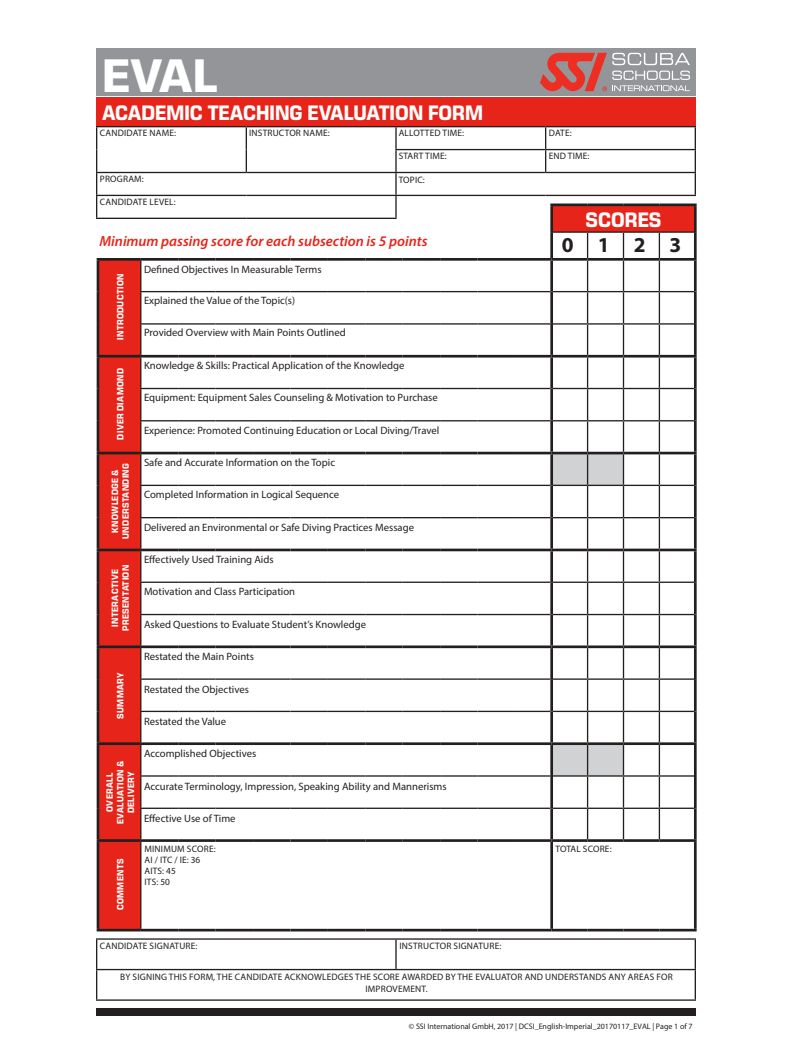
In the ITC you give microteachings – short academic presentations evaluated with the SSI form. The better you know the structure beforehand, the more time you have in the course for your own style.

Structure of an academic presentation

Chapters 1–6 · Assistant Instructor

A microteaching is not a lecture. You are not supposed to read out the chapter, but to check whether your students understood it – and add where they struggle.

ITC Manual · Lesson 4.1–4.2

What you work through in the ITC Manual

What academic sessions are for, which training aids you use, how an academic presentation is structured and how you stay on topic.

What we add

The Microteaching Builder guides you through the structure, the intro helper supports you with the opening. Plus our webinar and an example that was rated very highly in the ITC.

Evaluation: academic presentation

Every microteaching in the ITC and the IE is evaluated with these criteria.

Sign in to view

Self-check: can you explain this in your own words?

  • What are the three purposes of an academic session?

    ITC Manual, lesson 4.1

  • What does each part of the academic presentation evaluation form cover?

    ITC Manual, lesson 4.1 and the criteria sheet above

  • How do you notice that you are drifting off topic – and how do you get back?

    ITC Manual, lesson 4.2

No model answers on purpose: if an answer does not come easily, read the lesson again – or write your question in a note.

Workshops and active learning

Chapters 1–6 · Assistant Instructor

Students learn more when they do something themselves. When do you choose a talk, when a workshop – and how do you build it?

ITC Manual · Lesson 4.3–4.4

What you work through in the ITC Manual

Student-centred teaching, how to set up a workshop environment, the types of active learning activities and how to choose and build a suitable one.

What we add

The Microteaching Library with examples from other candidates – and your own first draft, on which you get feedback from us.

Self-check: can you explain this in your own words?

  • When is a workshop better than a talk – and when not?

    ITC Manual, lesson 4.3

  • Name three types of active learning activities and a dive topic each one fits.

    ITC Manual, lesson 4.4

No model answers on purpose: if an answer does not come easily, read the lesson again – or write your question in a note.

Create a first draft on a simple OWD topic in the Microteaching Builder. Which topic did you choose, and what was difficult?

Sign in to save notes here

Tools to prepare your microteachings

Chapters 1–6 · Assistant Instructor

To make the structure easier for you, we’ve developed two tools to help with preparation:

With the Introduction Generator, you can get AI help to craft the introduction to your chapter. But beware – your own brain is still required!

The Microteaching Builder guides you through structuring your microteaching and helps you avoid missing important components.

5 Chapter 5: In-water training 3 tasks

In the water, knowledge becomes responsibility: you decide when an exercise is safe, where you position yourself and when a skill is really mastered. Here we use many tools from divemaster training – that is where you learn to make decisions and lead groups.

Decisions, risk and group control

Chapters 1–6 · Assistant Instructor

As a diver you are responsible for yourself, as a professional for everyone. How do you make decisions in the pool, in open water and in between?

ITC Manual · Lesson 5.1–5.2

What you work through in the ITC Manual

Making decisions and managing risk, resources for professionals, positioning during a skill, in-water training without an assistant and communicating with hand signals.

What we add

Cases to play through: the Decision Trainer, building groups, rating risks and looking back at incidents – plus the dive planning flow.

Quiz: Rating risksDiving, risk and perception – a short reality check.
Open quiz
Quiz: Incidents and hindsightHow judgements change when you know the whole story.
Open quiz

Self-check: can you explain this in your own words?

  • What distinguishes the duties of a professional from those of a diver?

    ITC Manual, lesson 5.1

  • Where do you position yourself during a skill in the pool – with and without an assistant?

    ITC Manual, lesson 5.2

  • Which resources help you manage risk?

    ITC Manual, lesson 5.1

No model answers on purpose: if an answer does not come easily, read the lesson again – or write your question in a note.

Teaching skills: briefing, demo, debriefing

Chapters 1–6 · Assistant Instructor

Beginners learn from you, step by step. They do not know that you exhale through the nose to clear the mask – you have to show it so clearly that they can copy it.

A note from us about the IE: there you show the skill to the end and reset on mistakes, so that it is visible when you accept an exercise as passed. In real teaching a skill is rarely perfect the first time – you practise it with your students many more times.

ITC Manual · Lesson 5.3–5.4

What you work through in the ITC Manual

The teaching process: suitable equipment, more time with your students, the SSI skills philosophy, briefings for pool and open water, spare mask and spare weight, alternate air source configurations, evaluating a demonstration and the debriefing.

What we add

Our workshop on demonstration quality, the discussion “To kneel or not to kneel?” and the criteria sheet your in-water teaching is evaluated with. You find the skill videos in the SSI Skills Review.

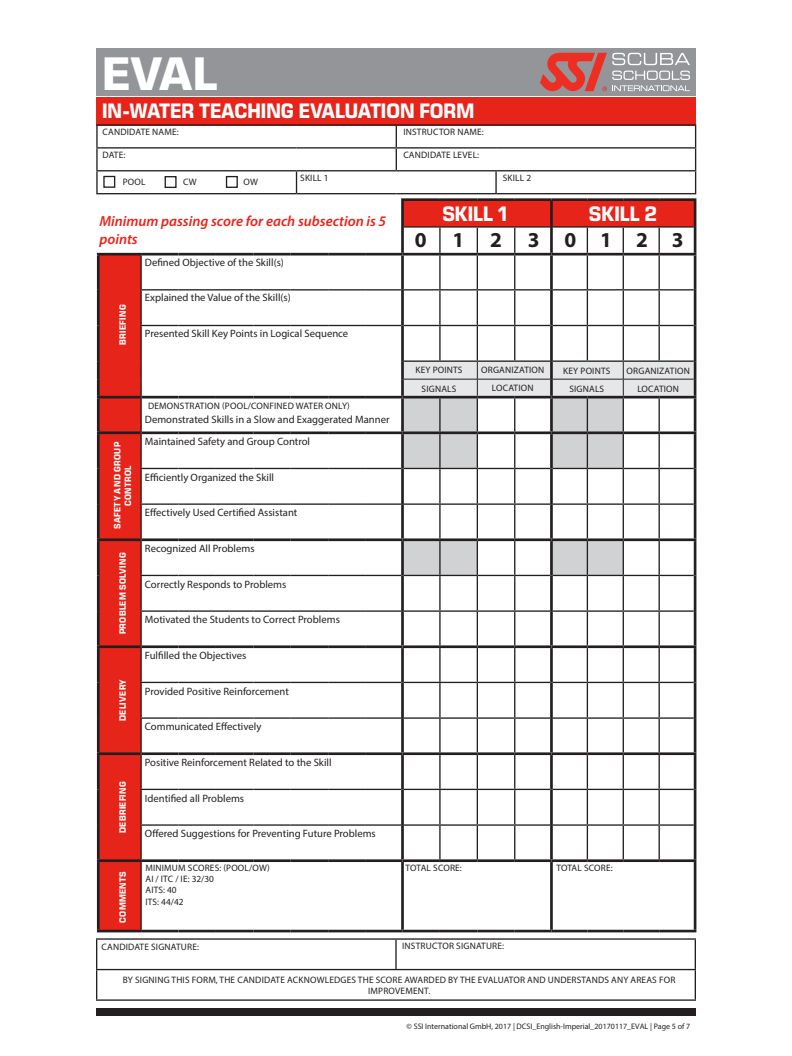
Evaluation: in-water teaching

Your in-water presentations are evaluated with these criteria.

Sign in to view

Self-check: can you explain this in your own words?

  • What goes into a skill briefing in the pool, and what into one in open water?

    ITC Manual, lesson 5.4

  • Why do you carry a spare mask and spare weight as an instructor?

    ITC Manual, lesson 5.4

  • How do you recognise that a demonstration is passed?

    ITC Manual, lesson 5.4 and the criteria sheet above

No model answers on purpose: if an answer does not come easily, read the lesson again – or write your question in a note.

Write the briefing for a skill of your choice, for example “mask clearing” – short and crisp, the way you would say it at the water.

Sign in to save notes here

What is true demonstration quality?

Chapters 1–6 · Assistant Instructor

You show someone underwater what they should do – and they don’t know it yet, have never done it, and are learning it right now. From you!

What you show now matters: beginners learn from you and must be able to follow step by step. They don’t know they must exhale through the nose to clear a mask; they don’t know they’ll swallow water if they don’t blow out the regulator; and they don’t know what to do with the buttons on the BCD. They are busy breathing – maybe also not drifting away. They don’t remember your briefing – you must show them very clearly again how it works now!

Hover or kneel?

6 Chapter 6: Assistant Instructor programs 4 tasks

As an Assistant Instructor you teach your own programs: Try Scuba, Basic Diver, Scuba Skills Update, some specialties and the Explorers for children. What counts here is applying the standards with confidence.

Try Scuba, Basic Diver, Scuba Skills Update

Chapters 1–6 · Assistant Instructor

The short programs are often someone’s first contact with diving – and decide whether they come back.

ITC Manual · Lesson 6.1–6.2

What you work through in the ITC Manual

Standards and formats of Try Scuba and Basic Diver, the digital recognition card, advising students after the program and the Scuba Skills Update for divers who have not dived for a while.

What we add

With the Try Scuba Briefing tool you create a complete briefing for a try dive. The dive environments tool shows which depths apply in which program.

Self-check: can you explain this in your own words?

  • How does a training center use Try Scuba and Basic Diver to win new divers?

    ITC Manual, lesson 6.1

  • What are the three steps of advising someone after a Try Scuba?

    ITC Manual, lesson 6.1

  • Who is the Scuba Skills Update for, and what does it include?

    ITC Manual, lesson 6.2

No model answers on purpose: if an answer does not come easily, read the lesson again – or write your question in a note.

Specialties and SSI Explorers

Chapters 1–6 · Assistant Instructor

Specialties turn new divers into committed divers. And children have their own age rules that you need to know for sure.

ITC Manual · Lesson 6.3–6.4

What you work through in the ITC Manual

The standards of SSI specialty programs, how to meet the needs of new and experienced divers, and the SSI Explorers program for children.

What we add

Kids Standards answers the age questions for a specific child and program. With Specialty Packs you put together sensible packages.

Self-check: can you explain this in your own words?

  • Which specialties may you teach as an Assistant Instructor?

    ITC Manual, lesson 6.3 and the training standards

  • Which depth and age limits apply to the SSI Explorers?

    ITC Manual, lesson 6.4; check with Kids Standards

No model answers on purpose: if an answer does not come easily, read the lesson again – or write your question in a note.

The Open Water Diver at a glance

Chapters 1–6 · Assistant Instructor

As an Assistant Instructor you teach parts of the OWD. For that you need to understand the whole course – not just your lesson.

ITC Manual · Lesson 6.5

What you work through in the ITC Manual

The flow of the Open Water Diver program and its academic sessions.

What we add

OWD Logic explains the modular system with examples, the OWD course planner lets you build a whole course. Plus our webinar on how to run really good OWD courses.

Chapters 1–6 completed

Chapters 1–6 · Assistant Instructor

Once you have completed chapters 1–6 in digital learning, tick it off here.  It also counts on your ITC roadmap if you take the ITC with us.

Sign in to save notes here
7 Chapters 7–8: Open Water Diver and specialties 3 tasks

From here on it is instructor material: you are responsible for the whole OWD and teach Advanced, Nitrox and further specialties.

Chapter 7: The Open Water Diver program

Chapters 7–10 · Instructor

What the OWD is for, what you owe your students and which certifications exist besides the OWD.

ITC Manual · Lesson 7.1–7.2

What you work through in the ITC Manual

Purpose and standards of the Open Water Diver program, the instructor’s responsibilities towards students and the certification options such as Referral Diver and Scuba Diver.

What we add

In the OWD course planner you build course variants with Referral or Scuba Diver, the standards quiz trains quick look-ups, and the dive environments tool shows the limits per dive.

Self-check: can you explain this in your own words?

  • What are the three responsibilities of an Open Water Instructor towards their students?

    ITC Manual, lesson 7.1

  • How do Referral Diver and Scuba Diver differ from Open Water Diver?

    ITC Manual, lesson 7.2 and the training standards

No model answers on purpose: if an answer does not come easily, read the lesson again – or write your question in a note.

Structuring an OWD course

Chapters 1–6 · Assistant Instructor

To truly tailor your courses to your students, you should be able to adjust them flexibly. For that, it’s important to understand the structure of the pathways to OWD and the full course.

Here you’ll find tools to understand the modular system and the OWD course.

Chapter 8: Advanced, Nitrox and specialties

Chapters 7–10 · Instructor

The Advanced Open Water Diver, Enriched Air Nitrox and the specialty programs – and how you keep risks small.

ITC Manual · Lesson 8.1–8.3

What you work through in the ITC Manual

Structure and delivery of the Advanced Open Water Diver, how an advanced dive is upgraded to a specialty, the standards for Enriched Air Nitrox and risk minimisation in specialty programs.

What we add

Our Nitrox course with its own training record, the Nitrox quiz and the calculators for MOD, best mix and EAD – so you do not just calculate Nitrox, you explain it.

Quiz: Understanding NitroxTest your Nitrox knowledge.
Open quiz

Self-check: can you explain this in your own words?

  • Which parts make up the Advanced Open Water Diver, and how do you upgrade an advanced dive to a specialty?

    ITC Manual, lesson 8.1

  • Which risks do you minimise in specialty programs – and how?

    ITC Manual, lesson 8.3

No model answers on purpose: if an answer does not come easily, read the lesson again – or write your question in a note.

8 Chapter 9: Stress & Rescue and Divemaster 2 tasks

Stress & Rescue is the most important course after the OWD – and as an instructor you also train divemasters. Many tools from our divemaster world fit here.

Diver Stress & Rescue

Chapters 7–10 · Instructor

Who comes to the Stress & Rescue course, and how do you make it more than exercises at the pool?

ITC Manual · Lesson 9.1

What you work through in the ITC Manual

Who typically takes Diver Stress & Rescue, the value of the program, the standards and how to run the academic and practical parts.

What we add

Interactive cases for an emergency: the unresponsive diver underwater, the neuro check, the practice game with the O2 kit and the case trainer “O2 or not?”.

Self-check: can you explain this in your own words?

  • Which two types of Stress & Rescue students does the manual describe, and what does each need?

    ITC Manual, lesson 9.1

  • How do your students transfer what they learned to real situations? Give two examples.

    ITC Manual, lesson 9.1

No model answers on purpose: if an answer does not come easily, read the lesson again – or write your question in a note.

Training divemasters

Chapters 7–10 · Instructor

As an instructor you evaluate the briefings and guiding of future divemasters and plan the logistics of whole programs – including what training really costs.

ITC Manual · Lesson 9.2–9.4

What you work through in the ITC Manual

The academic overview of the Divemaster program, the practical applications with the evaluation forms for dive briefing and dive guiding, and program logistics with a program plan and the true cost of training.

What we add

Our divemaster world: the training diary, the SSI criteria for briefings with an explanation for each point, exercises on cylinder logistics and dive groups, and the Decision Trainer.

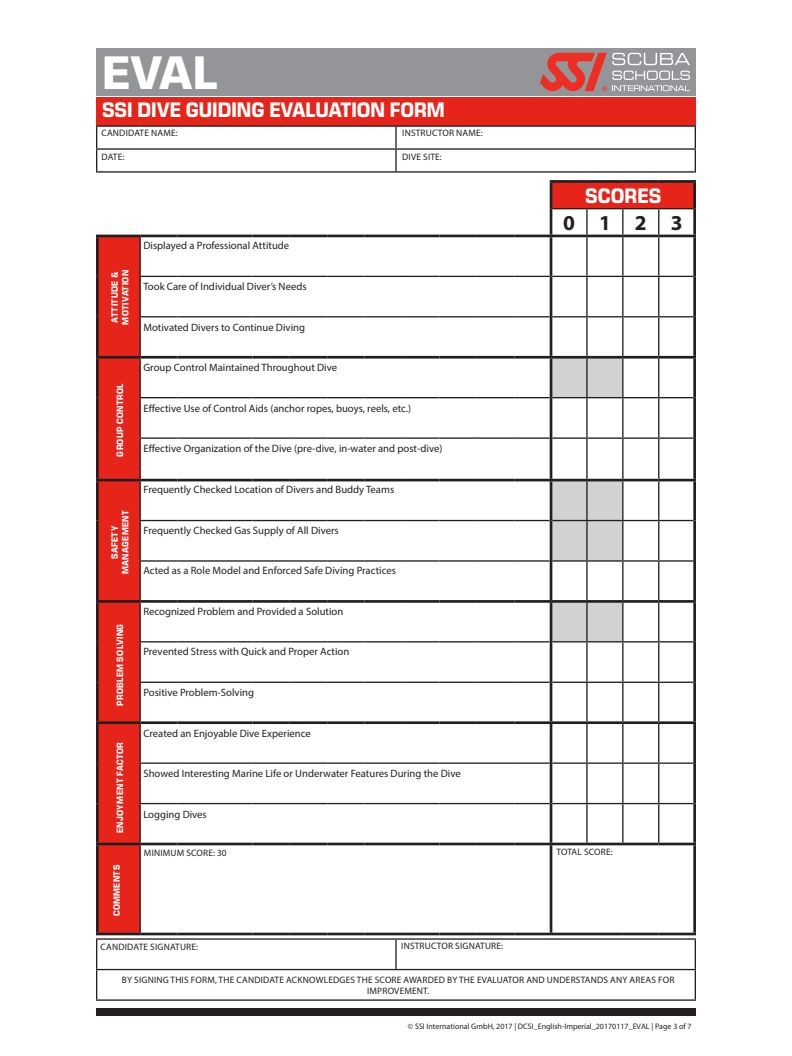
Evaluation: dive guiding

This is how a divemaster’s guiding is evaluated.

Sign in to view

Self-check: can you explain this in your own words?

  • Which forms do you use to evaluate a divemaster’s briefing and guiding, and how do they differ?

    ITC Manual, lesson 9.3 and the criteria sheets

  • What goes into a program plan for a Divemaster program?

    ITC Manual, lesson 9.4

  • Which costs of training are easily forgotten?

    ITC Manual, lesson 9.4

No model answers on purpose: if an answer does not come easily, read the lesson again – or write your question in a note.

9 Chapter 10: The business of diving 2 tasks

Diving is also our job – we want to make a living from it. The last chapter shows the industry from the training center’s point of view: acquiring, developing, committing and retaining customers.

Your role in the dive business

Chapters 7–10 · Instructor

What a course should cost, how customers become committed divers and how the industry can improve its working conditions.

ITC Manual · Lesson 10.1–10.5

What you work through in the ITC Manual

Your role in the dive industry and the customer loyalty cycle with acquisition, development, commitment and retention – including the role of owning equipment.

What we add

Our business workshop as a Mural to calculate along, the webinar on the job as a dive instructor and pointers for everyone who wants to make a living from diving.

Self-check: can you explain this in your own words?

  • What are the four phases of the customer loyalty cycle?

    ITC Manual, lesson 10.1

  • What is your role as an instructor in acquiring new customers?

    ITC Manual, lesson 10.2

  • How do you recognise a committed diver, and how do you keep them active?

    ITC Manual, lessons 10.4–10.5

No model answers on purpose: if an answer does not come easily, read the lesson again – or write your question in a note.

What do you want to do with your qualification – full-time, on the side, at a resort or at home?

Sign in to save notes here

Chapters 7–10 completed

Chapters 7–10 · Instructor

Once you have completed chapters 7–10 in digital learning, tick it off here.  This also counts on your ITC roadmap if you take the ITC with us.

Sign in to save notes here
10 Outlook: ITC and IE 4 tasks

At the end of the ITC comes the Instructor Evaluation (IE). You do nothing new there – only what you practised in the ITC. Starting well prepared leaves more time for practice in the course.

What to expect in the IE

IE outlook

An SSI Instructor Certifier evaluates theory, presentations, skills and rescue – and talks with you about the SSI system. In the written exam you may use the standards, but time is short: if you can look things up quickly, you have a clear advantage.

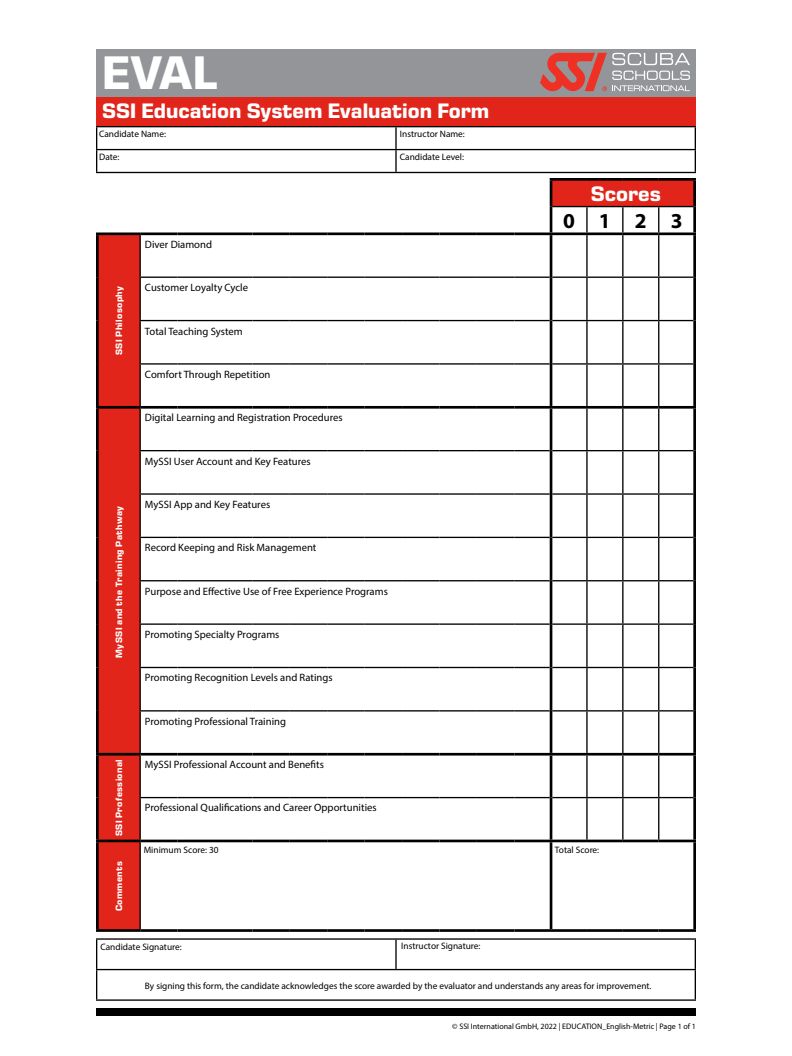
Evaluation: the SSI education system

These questions and criteria apply to the conversation about the SSI system in the IE.

Sign in to view

SSI Exam Trainer: practise the final exam

IE outlook

At the end of the ITC you take the SSI Final Exam, and in the IE an exam on the standards. With the Exam Trainer you practise the exam topics so that you understand the content – not the order of the answers.

For every answer, say honestly whether you knew it, looked it up or guessed: that decides when the question comes back. For now your progress is only stored in this browser.

Ready for the ITC?

Take the quiz from the start again and compare. Then tell us where you still need support.

Quiz: Ready for the ITC?How has your result changed?
Open quiz

What do you take away from the preparation? Where do you still need support before the ITC?

Sign in to save notes here

Take your ITC with us

If you want to take the ITC with us on La Palma, the ITC roadmap is your next step: there you find the in-person phase, your evaluation forms and your course calendar. Everything you ticked off here comes with you.

Punkfish SSI ITC

SSI standard – binding

Before the ITC academic sessions start, SSI requires: the pre-assessment exam with 100 % and the digital learning review questions with at least 90 % – chapters 1–6 for Assistant Instructor, chapters 1–10 for Open Water Instructor.

Source: SSI ITC Trainer Manual, candidate preparation

SSI standard – binding

The pre-assessment covers physics, physiology, decompression, equipment, the aquatic environment and the general training standards. You must pass it with 100 % before the academic sessions start.

Source: SSI ITC Trainer Manual, candidate preparation

SSI standard – binding

You complete the digital learning review questions with at least 90 %: chapters 1–6 for Assistant Instructor, chapters 1–10 for Open Water Instructor.

Source: SSI ITC Trainer Manual, candidate preparation